

With a sudden crack, the townhouse momentarily reflected bright blue light from every corner before once again turning dark from the oncoming storm. The flash and crack startled Don back to his present reality. He rested on ablue corduroy chair placed squarely in front of the television: his usual place to stay since the company closed down the restaurant.
Don remained unmarried, turning his attention to his career, not as a mere line cook as some may precociously assume when casual American conversation demanded to know his occupation. He was, in fact, the general manager of his location, a long-time company employee. He started in high school as aline cook, but proved himself, seeing the opportunity to take management courses, paid for by the restaurant of course, as a fine alternative to college. Dondid better than most of hispeers, anyway. That was before.
Now nearly everyone he knew was out of work, wasting away in front of their televisions. A few of his friends were able to keep on working from home, if you could call it work. His best friend, Sam, complained that working from home was a distraction, especially after all the schools closed down. The balance to learn to work while perpetually distracted by the joys of family life is a daunting task, but at least Sam still had a paycheck coming in to ward off the mortgage bill.
Most of Don’s friends used the opportunity to clean up their house. Don remembered the last days of freedom, had it only been a month? His restaurant was overrun with customers, to and fro preparing fora variety of choirs, stocking up on previously unsought items…who really needed that much toilet paper anyway? Other items were the paint to finally refresh that old room, or shelves, to organize the garage. Even Don participated in storing up materials for projects at home. The government-mandated break would certainly hurt the pocketbook, but at least he was out of excuses for the laundry list of household choirs. Like his friends and neighbors, however,cabin fever set in within about a week once he finished allthe projects. Now he perched himself in front of the television with nothing to do. The thunder outside was a welcome change to the regular dreary clouds.
He looked back up, fixing his eyes on the television. The reporter had another update:
The virus is still spreading. It would appear from the continued spread that people are not maintaining the required social distancing, so the government has now issued a new order. Everyone is to remain indoors unless there is an emergency requiring you to leave your house. All essential employees will be given a license to leave their residence. Checkpoints will be established at key positions throughout the state. Do not leave your residence without a license. In the event of an emergency, call your local health department to receive a temporary license number. This new curfew will be in effect starting at 8:00 PM tonight.
Don reached for the newspaper. More news about the virus spreading in the big cities. The news reported few confirmed cases in Jefferson County, but the hospital sent all the infirm home to recover peacefully there. Still, the paper indicated Jefferson would be the test locationfor a new ‘early warning’ experimental protocol. The authorities opted to use Jefferson because the virus had not yet spread far into the community including a small city andseveral country towns. Lacking interest in the next sitcom rerun, he muted the television to focus on the new early warning system as presented in the newspaper press release:
The Mandrake Virus has been spreading across the United States, and other countries, at an unprecedented rate. Scientists around the globe have been working tirelessly to control the spread of the infection. Social distancing appears to be helping the spread in some cases, but nevertheless, the virus continues to spread. One key measure for control is to determine who has been infected by the virus. Jefferson County is pleased to be selected as the first test of a novel product that hopes to identify infected persons so better quarantine measures can be taken.
The new device is a ring which constantly measures your temperature and other vital signs. The Bluetooth connection to your device will connect with the app and notify you if your vital signs indicate you are likely to be infected with the Mandrake Virus. From the app, you can alert the authorities and they will deliver a home kit to prepare an official test.
Each resident’s ring will be delivered directly to their house. The National Guard will help everyone set up the device, so please have your phone ready when they arrive at your door between 9:00 and 6:00 daily. In the event you are an essential employee, you will receive your ring at your place of work.
Don read the article a few times. He focused on the second and third paragraphs the most. He didn’t need an education on the Mandrake Virus. Don, along with every other citizen of Jefferson County, and the state, and the country, and the world, had been receiving a daily crash course in the virus for two months now. It had surpassed education; it was now indoctrination.
A new device that always measures vitals. That might be useful information. Perhaps this would not be a bad thing. But Don caught a problem: He didn’t have a smart phone. He knew for sure this thing would not connect to an app on his old landline. Yes, Don was not specifically anti-technology, but his formerly regular routine placed him at home, at work, or at church. All making a triangle of travel less that a few miles.
Not that he never traveled. When he did go on vacation, or to visit the folks, or on the short trips to just get out of town, he would borrow an extra phone from Sam. As simple as Don made his life, Sam’s was equally not simple. Heworked in technology. He knew about computers, and phones, and teleconferencing. Samwas a techno-guru. Perhaps the contrast between their two lifestyles was the reason they remained friends for so long. They could share their experiences with each other, giving one another just a taste of the differences between their worlds. For one day a week, every Friday, they would play cards, shoot the breeze, and laugh the day away. He had not seen Sam in a month since the first lockdown order. At least phone calls still worked, so he picked up his old cordless telephone and dialed Sam from memory.
“Hi Sam. Got a minute?”
“Sure, Don,” his friend replied, “what’s up?”
“I’m reading the newspaper about this new device they want to give out to everyone. Have you seen anything about it?”
“Just what was on the front page of the local news this morning,” Sam said, leaning back in his chair.
“Well, it says here that it needs to connect to a phone app of some kind. What happens if I don’t have a phone to connect to?”
“Yeah,” Sam sighed, “I am not sure. I really do not want to put another app on my phone. Actually, company policy: I can’t put anything on my phone anyway! The IT department for work needs to approve applications. I am worried about this thing, though. Apps can connect to the Internet. I wonder if this app shares data…I would expect it to if this is a test.”
“Did you see anything about rejecting the test? Isn’t there something in the law about requiring consent to take part in a study?” Don asked.
Sam had not thought about that, but his college ethics courses did indeed teach about human review boards, the application and consent forms, and the rest of the red tape needed for a human trial.
“That’s a good question,” he said inquisitively.
Don heard the click-clack of a keyboard as Sam hammered a question into a search engine. Don heard this sound before; he knew Sam was looking something up, so he let the air remain dead for a period of time, knowing his computerphile-on-call was likely reading an article.
“I found some info here,” Sam finally voiced. He started to read.
In light of the global pandemic, the Ring Relief Project, RRP, was granted emergency status to be deployed across Jefferson County. The project does not require consent because it is a non-invasive device that is worn on the finger. All citizens much comply with the order, exceptions will only be granted by special permit of the research office.
“And there is more here about whom to contact for more information and how the device works,” Sam concluded.
“Is this a little weird to you?” Don asked, still trying to process this whole idea of being part of an experiment for which he did not want to participate.
“Yes, it is,” Sam echoed his own concerns back, “I specifically wonder how it will work when I can’t install their app on my phone.”
“Or the fact that I do not have a phone to install an app on at all!” Don replied back.
“There is that. I guess the best you can do is ask whoever drops this thing off,” Sam said, sounding distracted in the last part of the sentence.
Sam’s office had just been invaded by his two kids, Mike and Alice, playing tag. Don heard the muffled laughs through the headset as they expended the pent-up energy on a rainy day. Don heard the laughing yells of ‘I got you’ and ‘no you didn’t’.
“Ha, ha, ha, sorry about that. The kids are taking a break from the assignments. It looks like I need to go do the dad thing for a while.”
“Alight,” Don said, “Great talking to you,” and he hung up the phone. He studied the newspaper again, this time with a brick in the pit of his stomach, unable to shake of the malaise of being forced into a county-wide research project without a say.
Only for Supporters
To read the rest of this article and access other paid content, you must be a supporter

Thanks for your support. By supporting SwitchedToLinux, we are able to spend more time working on tutorials and looking at software to help people make the transition from spying software to tools that respect our rights.
It might just be me, but I've found even on GrayJay I don't get your SwitchedToLinux YouTube streams, or anything YouTube for OurWalkInChrist, instead I only see that you've uploaded or are live from Rumble (and sometimes Twitch), or from going to your channel page. I wonder if YouTube is interfering with being able to see your stuff on third party apps as well.
@SwitchedToLinux Just watched your recent video on Western Digital. FYI - You can install Windows To Go with RUFUS. I have a Windows 10 and 11 installed on 32 GB USBs. They work without issue.
The footsteps of both men echoed down the institutional hallways as Simon, being led by his new supervisor, looked at the random notices on the walls interspersed between research doors. Many of the closed doors had paper over the windows, blocking out any presence of other people in the seemingly empty building.
“Our offices are down this way,” he reminded Simon, remembering he only visited the office space once in the interview process.
The door swung into a receptionist's office. The large, scowling woman glanced up from the computer screen.
“Hi John,” she said with disinterest.
“Do you have Simon’s packet ready?”
“Uh huh,” she said, retrieving a file folder and blindly handing it up.
“Thank you...Sally,” Simon said, hesitating to read the nameplate on her desk.
“Uh huh,” she mumbled again, still affixing her eyes to the computer screen.
John led him passed the desk and through the door straight down the hall. The door opened with a ratty creak, and the two men stepped inside.
“I got your replacement, Mike,” John said to the man sitting in front of a panel of computer screens.
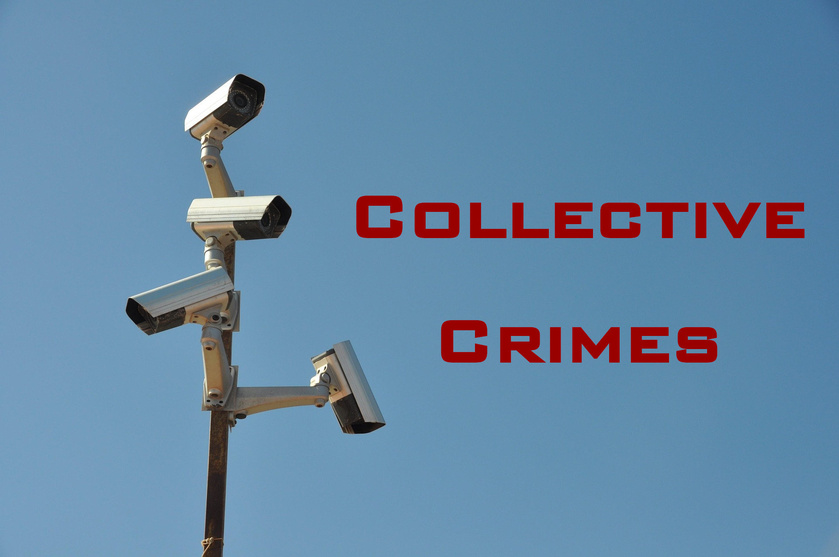
He turned to Simon and shook his hand. “Welcome to Collective Camera Co.”
-----
Simon walked around the room looking at all the equipment. The room clearly monitored several cameras, all of which randomly cycled through different streets. The screen detailed a printout of all vehicles passing through a collection of records like a compiler spitting out lines of code. An occasional beep alerted the monitoring room of an anomaly by outlining screens in red, waiting for a button to be pressed after acknowledging.
Each computer processed information for five monitors. All three computers synchronized the LED colors in the cooling fans. The single screen rolling the log of captured vehicles emanated from a separate computer, different in design from the others.
Turning his attention away from the monitors, a small desk with a simple desktop computer sat upon the far corner of the room. A dorm refrigerator fit under a small stand with a coffeepot. A few jugs of water closed the gap between the refrigerator and the wall. The room’s remainder was plain and institutional.
“Are you from these parts?” Mike asked.
“Nah. I just moved here. Came from Austin. I needed to get away from my crazy ex.”
“I know that feeling,” Mike said. “Not from personal experience. My wife and I have had twenty lovely years. But my ex-sister-in-law is a psycho!”
“So, why am I replacing you?” Simon said, changing the conversation topic.
“I needed a little more bread, so I’m changing companies to find a raise.”
“Can’t you get a raise here?” he asked.
“The company issued wage freezes a few months ago. They are trying to tighten our belts to loosen a few notches for the investors. The C-suite still gets their adjustments. A bit of a travesty.” Mike offered.
“I was wondering why they asked if I would be happy with the hiring wage for at least a year.” Simon countered.
-----
Simon shoveled the last of the microwave Salisbury steak into his mouth and washed it down with the last of the cola. He pushed the tray to the center of the table and grabbed the stack of mail. He opened the first credit card bill, seeing the balance. The interest alone accrued more than he wanted to pay on a single card, but the line about taking seventeen years to pay it off made the steak settle like a rock in the pit of his stomach.
“The age of a minor child,” he mused to himself. “That’s how long I pay for this crap.”
With a nodding head, he neatly placed the statement down on the table and grabbed another piece of mail. The electric bill rose twenty percent. An insert in the bill explained the rise in costs incurred because of the increase in demand for power from the community. Another forty dollars beyond what he expected. The remaining bills added up to more than he had budgeted for basic expenses. His neat pile of bills called to him, but he ignored the call and plummeted into his chair, switching on the television to numb his brain some more.
“At least I found a job,” he muttered to himself.
Being unemployed for a few months added to his debt, and his wage is not what he had hoped he might incur for the experience in computer systems he brought to the table. The subtle sounds and lights hypnotized him into a deep sleep in the chair.
-----
Simon walked down the hallway with more confidence than he had on his hiring date three weeks ago. The blackened doors no longer intrigued him, and a confident stride replaced his formerly sheepish steps. He opened the door to the offices, greetings Sally.
“Uh huh,” she always said, as he walked past her without stopping and into his room.
He opened the door to darkness for the first time. Mike moved on to his new job today, so Simon leaned on his training alone for the first time.
Without supervision, he watched the monitors and glanced over to the log, adding new vehicles and appending the database of the pre-existing ones. The screens lit up with notices and flags, all perfectly managed by Simon, a master of the data.
The door opened unexpectedly. John walked in with a paper in his hand.
“We received a warrant. Did Mike walk you through the procedure?”
“No,” Simon said, “but I read the SOP a few times. I should be able to handle it.”
“Great,” John said, handing him the paper. “Get me the full readout on the central server. Once I look it over, I’ll pass it on.”
Simon looked at the paper and nodded to John, who quickly dismissed himself from the room.
Simon approached the computer and opened up the paper. He expected something in the local town, but the warrant looked for the traveling routes of a car throughout the streets of New York City. He punched in the license plate number and found the vehicle in the database. A mapping option showed the various places the car had been recorded by Collective Camera Co, pinging around NYC with timestamps besides a few common destinations in New Jersey and into a small town in Pennsylvania.
He copied the report into a shared folder with John and drafted an email informing him the data awaited review. The report happened quickly, and with no pushback.
“I wonder,” he said to himself. He opened a terminal on the computer and searched for logs. He found the log showing the access to the information and tested adding a line to the document.
Success.
He removed the line and reset the modified date with a command.
“This is too easy,” he said to himself.
Pulling up the access screen again, he entered some information about himself. The database showed several cameras pinging his location with timestamps. He noted the streets to know where to avoid in the future.
He looked up his ex-wife. The cameras followed her around Austin as well. They noted the times she passed by their old house for work in the morning, and they caught her visiting her new fling. He spent a few hours looking at how much detail the cameras had over her movements. He traced the dates back a few months to their breakup and overlaid his car movements with hers, showing them occupying the same space. That was before. This is now. Simon is overworked and underpaid, and progressing into debt.
An idea ran through his mind.
“A data service,” he thought.
Collective Camera Co focused its database marketing mostly to governments and law enforcement with only a few targeted data brokers sharing reciprocity with data. But he had access to the system and the means to clean his access logs.
Simon launched an instance with an AI to create a webpage selling access to targeted location data for anyone in need. His hidden marketplace became indexed with hidden directories, and inquires started filling up a masked email address.
Only for Supporters
To read the rest of this article and access other paid content, you must be a supporter

Vittorio Fiorentino placed the newspaper on the desk and looked up to Tonio. The smoke from his cigar clouded the dimly lit warehouse corner.
“I see the authorities let the kid off with a warning.”
“As predicted, sir.”
“What was our take?” Vittorio asked.
“Only fifty dollars. Not bad for a rando.” Tonio answered.
“Indeed,” he said, puffing his cigar. “Soon we will not need to target the randos anymore.”
“Sir?” Tonio inquired.
The warehouse door opened, allowing in some noise from the city streets. A dark figure glided along the floor, approaching the corner of the room where the desk created a separate office space. The man reached into his jacket pocket and retrieved what looked like a phone. He placed it on the desk and nodded to Vittorio.
The boss picked up the device and clicked a few buttons. The screen displayed two names with a headshot of each person. One name included Tonio and the other, Richard, the man who brought in the device.
Vittorio clicked on Tonio’s name and read through the profile. He clicked the screen off and set the device back on the desk.
“Very good, Richard,” his raspy voice exhaled more smoke as if he were a conniving dragon. “Here is your payment, as promised.”
Richard nodded his head and took the bag, opening it to verify the boss actually paid him. He nodded again and turned to walk out.
Vittorio picked up the device and clicked back and opened the profile for Richard.
Salary estimated $150,000, usually pays cash, interested in gardening, baseball, and sports betting. Android phone, Windows computer, technology novice…
The list continued on. The boss now had a means to see information about the people in his vicinity based on the same tracking technology used in the new advertising kiosk roll-outs. As people walk down the city streets, the kiosks read the phone IMEI data and connect to the databases, determining what type of advertisement would best motivate them to buy something. His new device simply read the profile metadata to capture more relevant information for his enterprise.
“This thing works well, Tonio. See what it says about you!”
He clicked back onto his right-hand man’s profile and showed him the screen. Tonio confirmed the frightening accuracy of the report before him.
“Why aren’t you showing up?” he asked.
“I’m using a Faraday box. Something you will start using.”
-----
Tonio walked up to the bus stop and sat down on the bench next to a teenager. His leg nudged the kid, and they made silent eye contact. The teen nodded and winked at him. Tonio removed the device from his pocket and scanned the people in the vicinity. The device sorted profiles by net worth, so he clicked the top profile. This person used the digital payment system more often. The application also suggested few hobbies. The second profile showed a woman’s face. He clicked through to see a person with a penchant for cash and coffee shops. He noticed the cash and identified that the bus’s next stop would be close to a coffee shop she frequented.
Tonio full-screened her picture and scanned crowd. He spotted her and nudged the kid again. He showed him the photo and pointed to her in the crowd. The teen acknowledged the target. Tonio leaned in and whispered in his ear before standing up and walking away from the bus stop with the device in his pocket.
The teenager got on the bus and took a seat a few rows behind his target. He watched her pass time by scrolling her social media feed. She pulled the cord for the next stop and gathered her bag to get off the bus. The teenager also got off the bus at the back door while the woman exited at the front. Predictably, she went into the coffee shop. The teenager confirmed her entry and leaned against a light pole and texted out a few messages. He moved into the small alleyway and watched her from just beyond sight of the door.
The target eventually gulped back the rest of her coffee and tossed the cup away. The door pushed open into the humid night in the bustling city. She stretched out her arms and began the walk to her apartment at the end of the block.
The teenager stepped out of the alley with his knife already pressed against her stomach.
“Your life or your money,” he snarled into her face.
Fear gripped the woman, who could not help but let a tear out of her eye.
“Take it all,” she yelled.
A tall man heard the scream and yelled at the two people at the opening to the alley. The teenager snatched the bag at the end of the woman’s arm and ran into the dark alley. The tall man gave chase, but the teen’s knowledge and experience in the dark alley system outmatched him.
The man returned to the victim, failing to apprehend the teenager. By this time, the woman had already pushed the panic app on her phone. The app gathered all the data of all the people in her vicinity for the last five minutes, allowing the police narrow down suspects. The police arrived and spread out to talk to everyone on their list who matched the description the woman provided.
Only for Supporters
To read the rest of this article and access other paid content, you must be a supporter
Ellas leaned back on the bench seat, watching the autonomous cars go by. As usual, riders only occupied about half of the cars in movement. The empty cars routed automatically to pick up a rider or being shuffled around by the central scheduling system for strategic deployment. Many vehicles started creating a double file line around the Prod Segment central administration building to prepare for the first shift of employees to leave to fetch a ride back to their unit.
She glanced at her phone, checking on the location of the Tranzport bus. Still a few minutes away, so she turned to the familiar stranger sitting next to her on the bench.
“How’s your son doing in school?”
“Good,” the lady said. “You’re Ellas, right? Council Member Alaric’s wife?”
“That’s right,” Ellas answered.
“That’s great. Is he still at the Crescent Segment?” The lady asked.
She had read about the trade negotiations with the other Segment in the Pollentia Times, as the efforts to keep peace through trade always landed at the top of all the news feeds. Pictures of the Council families often raised them to celebrity status, something that always irked Ellas.
“He is due to arrive back here, then he has to sit in quarantine for a week before he can come home. I hate that part the most.”
A simultaneous notification beeped on both their phones. Ellas glanced at the screen and stood up, awaiting the Tranzport bus. The other parents also stood up and approached the terminal. The bus arrived, ringing the clearance alarm, before opening up the doors to a flood of children pouring out.
“I’ll talk to you later,” she said out of politeness to the familiar stranger, then called out, “Nikolas!”
A dark-haired boy ran up, grasping her thigh.
“Hi, Mommy!” he said.
She looked at him with a smile and took his hand to walk down the stairs to the sublevel for the walk home.
“What did you learn in school today?” She asked.
“I learned how our world made peace with each other,” Nikolas said, jumping from square to square on the floor pattern, trying to avoid the cracks.
“Tell me about it,” she encouraged.
“Since people think differently,” he said, making another jump, “And no one could agree, we decided moving apart from each other was the best solution, so everyone here believes the same thing!”
“Very good, Nikolas. And what are the cities called?”
“Um,” he thought, “Segments!”
“Good.” she said. “And you know your daddy works with the Segment Officials to keep peace between the Segments, right?”
“Yeah,” he said, looking sadly at the ground. “I miss Daddy.”
They reached a raised platform and walked up the steps to their unit. Ellas waved her hand over the security panel and the color switched from red to green with a beep. Nikolas ran inside and threw his bag on the floor without a care. Ellas followed him in and placed the bag up on the stand where it belongs. She grabbed her phone and swiped a notification off the screen, then she opened up the Tranzport app and clicked the button to request a ride for two. The screen confirmed the priority order for families of council officials and reported a five-minute wait for a car to arrive.
“Nikolas,” she called out, “We need to head out again.”
“Why?” He protested.
She placed her hands on her hips and gave him the eye she trained him with to obey without question.
“OK,” he said.
They walked out the door, hearing the lock alarm behind them. The two stood on the Tranzport pickup platform, awaiting the car. The vehicle arrived within a minute and opened the door. Nikolas jumped in first, then Ellas hit the door close button and confirmed the quarantine wing of the hospital was the intended destination.
----
“Daddy!” Nikolas yelled, running toward a glass divider wall.
“My boy!” Alaric declared with open arms. They both touched the glass opposite each other, longing for an embrace.
Ellas took her time walking up while father and son reunited through the miracles of glass containment and a functional sound system.
“Hi Alaric, were the meetings a success?”
“They were, honey,” he said. “We have a potential trade deal in the works, allowing our Segment to provide some raw materials for battery production, and they will provide software technology to streamline Tranzport scheduling, particularly around our Sunday worship schedules.”
“Did you get the feeling peace will remain between the Segments?”
“I learned about world peace in school today, Daddy!” Nikolas proclaimed.
The Global President attained general accord in Pollentia by a tactic of isolation and a strict code of conduct when representatives for two Segments meet together. The prevailing thought kept the peace by isolating people into pockets of deeply held beliefs, allowing each Segment to create their own regulations. Visitors had to remain silent when visiting a different Segment. Thus, peace was only as fragile as the mandatory natural zones between them. Woe to the ones, however, who traveled into those forsaken regions.
Alaric, for his part, worked in the council for his Segment negotiating trade deals between people with different beliefs. The hard work paid well and offered a rare protected means of traveling to see different Segments. Most Pollentian citizens have neither need nor permission to go outside their Segment.
“World peace,” Alaric said, “I wish peace resided in the hearts of men and not in the laws of our nation!”
“When can you come home, Daddy?” Nikolas said, looking up at his father.
“After my one-week quarantine period is over, then I can come home. But I’ll call you tonight and help put you to bed!”
Ellas’s phone beeped a notification that the quarantine visitation drew to an end, and the Tranzport car would be available in five minutes.
“Say goodbye, Nikolas. It’s time to go.”
Only for Supporters
To read the rest of this article and access other paid content, you must be a supporter
Sign Up for free to see more from this community or subscribe to SwitchedToLinux for $5/month to support SwitchedToLinux for more interaction and exclusive content.
Thanks for your support. By supporting SwitchedToLinux, we are able to spend more time working on tutorials and looking at software to help people make the transition from spying software to tools that respect our rights.